Showing posts with label Jerusalem. Show all posts

Wednesday, December 18, 2013

Culture in Tel Aviv


Tel Aviv is an energetic and somewhat gritty city, and traces its roots back only to 1909. That predates the establishment of the the State of Israel by a few decades, but still makes it virtually a new city and atmosphere-wise about as far away from the ancient walls of Jerusalem as you can get. Its early planners envisaged a garden city and the first Hebrew-speaking city, although today English and myriad other languages reverberate through its dense patchwork of streets.

Many visitors to Tel Aviv come and go with a stroll along the Tayelet Lahat (seaside promenade) or a dip in the Mediterranean as their chief souvenir, but the waters here run deeper than that: as a religious center the primacy of Jerusalem is beyond contention, but for most everything else, there's this city of 400,000 people that can sometimes feel much bigger than that.


Part of the reason for this is the outsized cultural life. The Tel Aviv Performing Arts Center is home of the Israeli Opera and world-class musical and dance performances. TAPAC, as it's also called, opened in 1994 and a newer wing houses the renowned Cameri Theater. Many productions feature screened simultaneous translation into English.


The Tel Aviv Museum of Art showcases works by greats like Picasso and Van Gogh and also has an impressive range of temporary exhibits featuring both Israeli and international artists. The main museum is located next to the TAPAC. The Helena Rubenstein Pavilion for Contemporary Art is a separate location.


Israel maintains something of a cultural edge where contemporary dance is concerned. If you have the opportunity to take in a performance of the Batsheva dancers or any other troupe at the Suzanne Dellal Centre for Dance and Theatre, don't miss it. The location in the heart of charming Neve Tzedek, Tel Aviv's first neighborhood (not counting ancient Jaffa) alone makes it worth your time.


Yes, Tel Aviv is an international city and has the artistic muscle and Madonna moments to prove it. But it's also an Israeli city, and there are plenty of cultural venues that highlight both Israeli history and Jewish heritage. An excellent place to start is the Land of Israel Museum (Eretz Israel Museum), which has fascinating exhibits of ancient coins, less ancient postage stamps, archaeology, ethnography and more.


The museum is made up of a series of themed pavilions linked by walkways. Don't miss the pavilion dedicated to ancient glassmaking, and another that illustrates the role of the Baron de Rothschild in the history of Palestine and Israel.

The Beit Hatfutsot Museum of the Jewish People is located on the campus of Tel Aviv University in Ramat Aviv. A short taxi ride from central Tel Aviv but definitely worth the trip for the detailed exhibits which emphasize the continuity of Jewish culture throughout history.


Military history buffs will enjoy the Israel Defense Forces History Museum, located right next to the HaTachana marketplace.

Get an eyeful of Bauhaus architecture along Bialik Street and especially tree-lined Sderot Rothschild (Rothschild Boulevard) and catch a whiff of history at the Hagana Museum at no. 23. This small museum traces the early history of the Israeli military.


Beit Dizengoff, the simple home of Tel Aviv's founding mayor at number 16 Rothschild. It's where David Ben-Gurion declared the establishment of the State of Israel and is now home of the Independence Museum.

Friday, May 3, 2013

The palaces of Jericho

The plate with the site plan of the Ministry of Tourism Palestinian Authority.

Attempt of reconstruction palace of Herod the the Great.

The ruins of a huge gazebo, above which stands the modern squatter.

Once upon a time it looked like this.

A terrace is located at the foot of the garden gazebo.

And here is the palace.


In ancient times, it looked like this.

All the palaces of Herod the most important facilities were baths


A few hundred meters to the left of the palace of Herod was another palace complex.


That's palace looked like initially.

There was a main hall is lined with a decorative stone tile floor.


And there was another room. In these lay-poster stone slabs under which circulates the hot air.

Ancient mosaic floors.

The pool, which by order of Herod, as if, by accident, drowned his wife's brother - the last of the Hasmonean

Such was the palace of the last decades before the onset of a new era. These two pools. Herod ordered to partially dismantle the bridge between them - and we've got a big reservoir.

Monday, September 3, 2012

Jerusalem. Rockefeller Museum.

In 1930, John D. Rockefeller, Jr., gave the money to build the Archaeological Museum in Jerusalem. Since then, the museum and named after him.

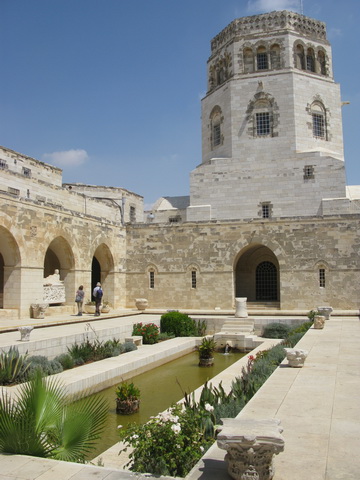
Austin Harrison - the architect commissioned to design the museum. Located across from the Old City walls and built of massive limestone blocks museum building more and more resembles a fortress.


The view from the porch of the museum


Museum driven by a Board of Trustees. In 1948, the division of Jerusalem, he was on  occupied  Jordanian territory. But continued to work as usual. Until 1966 - when King Hussein nationalized it. In 1967, the outbreak of the Arab-Israeli war. Israelis knocked Jordanians from Jerusalem and the West Bank. During the fighting in the tower housed the Israeli observation post. Since then the building is decorated with many marks of bullets. Now the museum is run by the Israel Antiquities Authority and the Israel Museum.


It is a native design turnstile the 30s. In working order.


In a large  introductory hall exposition dedicated to the creation of the museum and its history. Here, the layout of the complex made ​​by the architect and his death mask.


Rooms are on the perimeter and are called the cardinal. At the corners are octagonal domed tower - they also placed artifacts. Within the perimeter of the pool and courtyard with fountains. Round - arched gallery, under the arches of which are also available any antiquity.


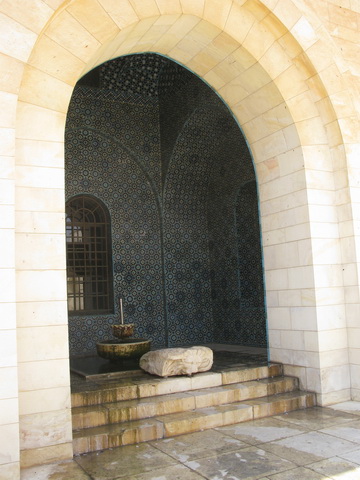
Opposite the main tower - vaulted hall, lined on the inside with ceramic tiles. Also with a fountain.


Roman sarcophagus


Fountain with drinking water in the hallway.


Halls of the museum.


In the halls there is no air conditioning. But the thick walls keep cool even in the strongest heat give a feeling of comfort. You can go to the patio and listening to the murmur of the fountain, sit in the shade by the pool.