Monday, September 19, 2011

Dubai's World of Islands


Dubai's World of Islands - one of the megaprojects in the UAE, goes under water. The islands of the archipelago are modeled after a system of continents on a smaller scale and fragmented. The photographs can be clearly seen by NASA as 300 islands gradually merge with each other and drown.

Small undercurrents persist in keeping their areas, despite the artificial boundaries of the archipelago, and now everyone is wondering who and how all counted. At the moment, the project managers were forced to admit that the island is gradually receding into the sea. Given that 70% of all the islands have already been sold to private individuals, the news that the "islands show strong signs of erosion" was a bolt from the sky.

Will there be some compensation for all drowned island or debited to the "natural force majeure" as yet unknown.

Thursday, September 1, 2011


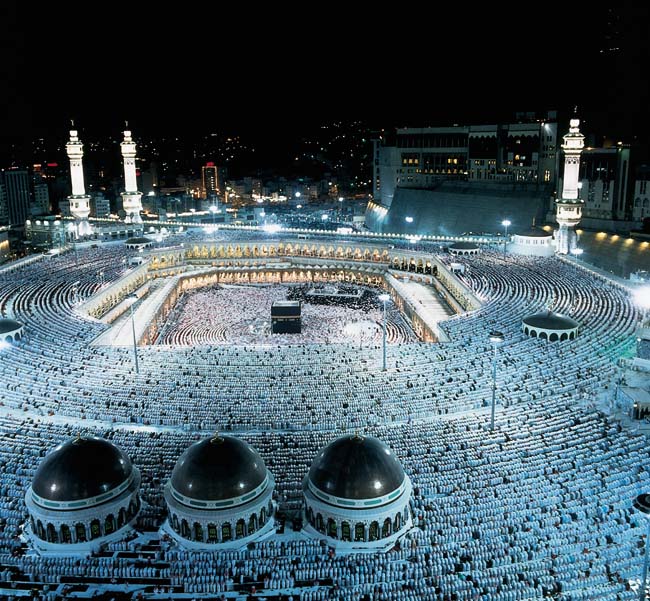
Every Muslim at least once in your life should make the Hajj - to visit Mecca. In centuries past it was difficult, troublesome and sometimes even dangerous. Hajj takes place under conditions of sufficient funds to visit Mecca and to ensure the family before returning pilgrim. If there are conditions, and Hajj is not accomplished, the sharia threatens the offender is a heavy punishment in the hereafter, and despising that debt equates to an unbeliever. On the contrary, the hajj fulfilled promises complete forgiveness of sins committed before that time, and the perpetrators of this pilgrimage proudly wore their white turban - a sign of the hajj.

In the past, everyone who came to Mecca had to find a matvafa - a guide who will provide not only a pilgrim accommodation and food, but will make sure that he did not commit errors in performing the rituals and prayers. Hajj procedure has so many subtle nuances that no Muslim (even the most earnest) on their own are difficult to handle.

At the heart of the hajj is tawaaf - a seven-fold treatment of the Kaaba. This procession symbolises the divine order in which all beings are subject to a single center - the solar system, as embodied in God. During breaking the Kaaba pilgrims reverently kiss the Black Stone, because deeply believe in Judgement Day he will call and talk to Allah the names of all the faithful, who kissed it with clean lips.

On the eighth day of Hajj from Mecca sent a huge procession to the hill of Arafat, to listen to the sermon of the Imam and perform special prayers. Approaching the hill, all the pilgrims pray without ceasing, and exclaim: "Lyabbayk" ("I obey you!"). In the valley at the foot of the hill Arafat, believers should spend the night, and only visited this hill the pilgrims receive the title of "Haj".

Wednesday, August 24, 2011

Kaaba Black Stone


In a small valley among the mountains, hidden from the world, is Islam's holy of holies - the city of Mecca. It is to him five times a day, turning the eyes of Muslims around the globe.

In contrast to other eastern cities of Mecca was not surrounded by a wall, and a natural fence of her have always been a mountain. Through the entire city stretches wide street Massana, to which many tiers down from the mountains slip at home - big and small. Middle of the street, at the very bottom of the valley, is located the area where the mosque stands the famous Al-Haram Al-Sharif, which means "House of God." Muslims believe that in this place is the center of the universe, because it did not even land, overturned on the ground of the sky. And in the last day of the world it to heaven and back.

The territory of "Sacred Mosque" - a sacred place for Muslims around the world. Have repeatedly referred to in the second sura of the Quran: "And no matter where you came out, pay your face in the direction of the mosque, and wherever you are, turn your face toward her." The area is similar to the traditional eastern courtyard, only a very large size. It is surrounded by three, and where the four rows of columns of marble, granite and stone of the ordinary. On top of the column are connected by pointed arches and domes are covered with small white, and towering above them seven slender minarets.

Go to Mecca turned their eyes the ancient Arabs, because of their pagan gods were also in the Kaaba. This church was the true pantheon of gods and could satisfy all requests. It was centered about 360 different idols and sculptures of deified persons. Among them - the Arab gods Ilatov, Uzza, Hubal and others, the Assyrian-Babylonian Marduk, Assor, Sin, Sumas and Astarte, the Jewish patriarch Abraham and Mary with the Christ Child in her arms.

According to legend the Arabs, the Kaaba was built as an altar for prayer, the ancestor of humans Adam. Adam suffered greatly from the fact that not only lost paradise, but also the temple where he used to pray to heaven. Then God will have mercy, and a copy of the temple was lowered to the ground.

In the center is a large stone cube height of about thirteen feet with a flat roof. This is the Kaaba, once a pagan sanctuary, and now the main temple of the Muslim world.

According to one version, it was Adam's guardian angel, overlooking the stone after the fall made his charge. When the Black stone descended from heaven, he was so white and shone so that it could be seen for four days' journey to Mecca. But gradually, from the sins of the human it darkened and darkened, until he was turned to black.

The nature of the Black Stone is still unknown. Some scientists consider it a very large meteorite, other researchers see it as a big chunk of volcanic rock of unknown, because the stony Arabia is replete with many extinct volcanoes.

When in 1630, Mohammed returned to Mecca from Medina, he threw out all the pagan idols of the Kaaba, but respectfully kissed his staff to the Black Stone. But even before Muhammad preached in Mecca decided to repair the severely ramshackle Kaaba. When it was necessary to move the black stone or other place it was a dispute between the families, which one is most worthy of this sacred mission. And then Mohammed will solve this problem very clever: he spread on the floor of the Kaaba his coat, put on his black stone, and then the elders of all the noble families raised the cloak from the stone.

Tuesday, March 22, 2011

Arabic Superstitions


Ceramic turquoise amulets in the form of eyes or a palm, and other talismans designed to keep their owner from envy, misfortune, evil eye or a hex, you can see everywhere in Egypt: at the front door in Cairo apartment, rear-view mirror almost every car on the clothing of most young children.

So beware, lavishing the usual "Western" duty compliments. As "looking good" or "how quickly your children are grown up!" may look like an open challenge if you do not accompany them with salutary expression of the small Shaa-lla! - "The grace of God!".

The Egyptians, like many Arabs believe that particularly vulnerable to evil eye are young children. Therefore, asking about their health, you have every chance to hear the answer "sick", "bad eating", etc. things. In the Egyptian hinterland still dress young boys in girl's dress, and even pierce their earlobes for earrings - so it's easier to trick Satan.

Another way to protect children from the evil eye - to give the child any stupid name, for example, Shahhat - "beggar." It is believed that bad luck certainly lose interest in the media is so unattractive nicknames and pass over.

In the 19 century, a western orientalist said that Egyptian mother, even in affluent families decorate children in indelible cast-offs and recommend them to go grubby, in order to divert the eyes of envious. He had seen as a respectable, well dressed and scented Egyptian woman walks with her child, whose face was smeared with soot. It was a well-established method of concealment of children of Satan and evil men.

The Egyptians still believed that to show someone the soles of their shoes means a person to express utter contempt. So be careful in how you sit when talking with his Arab companion.

Shoes left in the hallway criss-cross each other, provoke conflict, mostly family. These will and superstition set. For example, you can not mow at night hair and nails (like bad luck there with us), cleaning the apartment, too, should be dealt with only in the afternoon. And in any case we can not touch the needle and thread after sunset.

As for the very evil eye, from which the Egyptian mother so cherish their children, then the Egyptians fear is bright blue eyes, not black as it is accepted here. Therefore, the amulet made in the form of "Fatima Eyes", is usually blue.

Thursday, June 17, 2010

Arabic Etiquette: "Interrogations"...

The Arabs in general, inherent in a more peaceful than the Europeans, the ratio of the time. So if your standard business visit to an Arab country is scheduled, then be prepared for the fact that the program will continually violated. Any kind of negotiations and meetings should not be limited timeframes, and better pre-assume that will happen some delay. This is sometimes annoying representatives of Western culture, but if you start to insist on the implementation timetable, for example, then the Arab partner can give the impression that he is dealing with a very impatient person, and, moreover, excessively demanding.

Who first comes to the tent

Arriving at the office to the Arab partner in the appointed hour, you might not find him there. But you can be sure that the staff of his company will take you well. If you are offered coffee, served him in a small cup, and pour the coffee will be as long as you do not put a cup on the tray, after shaking her thumb and forefinger.

If your partner went out to Arabic to meet you halfway to the door, then, seeing you in his office, he will likely enter into it first, instead, to let the guests in advance, as provided for western tradition. This goes back to ancient times, when Badawi, inviting guests to his tent, went to his first, to show that there is safe and there is an ambush.

If you go anywhere with the Arabs, it must be remembered that the advantage is the one who is right. Therefore, at the entrance, exit, landing in the elevator, etc. first starts to move someone who is right.

"Interrogations"

At the talks the Arabs are trying to establish an atmosphere of mutual trust. Providing a warm welcome to a friend, business partner or just a stranger, the Arabs appreciated when the same attention to itself in relation to themselves. The introductory part of a business meeting - the greetings, questions, exchange of stock phrases - lasts a long time. In Arabic-speaking countries, whether talking on the phone, meeting in the office or on the street, according to Arab etiquette taken constantly questions as to its success, good health, family ... Such an "interrogation" can provoke a European, but for the Arabs it is very important. This is the basis of their etiquette and culture. Moreover, these duty issues does not imply the detailed detailed answers. Answers should be brief, sometimes, purely ritualistic.

Left hand

Being in Arab countries or even in the Middle East, we must remember that the left hand in the Islamic countries is considered "unclean". The same, incidentally, also applies to India. The fact that the left hand is used to wash intimate parts (washing instead of using toilet paper is quite justified in terms of hygiene, especially in hot climates). Therefore, transfer documents, business cards or gifts to it are prohibited, unless you previously did not tell them that you are left-handed.

If you are invited pilaf hands, using only his right hand. The notion of context of his left hand with failure, trouble, misfortune, and right - with happiness and success, as reflected in the Koran and the Bible.

Thursday, June 10, 2010

Arabic Etiquette: Making Acquaintance with the Arabs


When one becomes acquainted with the Arabs, just as with many other cultures, should be observed a certain ritual.

The man, regardless of age and position, always presents himself first to a woman.

Younger men or her position should be a senior: the boy appears the man, man - Sheikh, etc.

If acquainting people are equal in age and position, the blank should be submitted to a married man and an unmarried woman - to a married.

One man seems a group of people. The woman appears to couple the first.

Since the people who represent a new acquaintance, one must say Fursa Said, which is translated as "very nice to meet you" or "pleased to meet you." Literally, Fursa Said means "good luck".

When acquaintance or meeting agreed to exchange handshakes. The custom of shaking hands has a long history and deep meaning. And the fact that for a handshake should be directed to the right hand, is not accidental. After all, the right hand is almost always clutching a sword hilt. Offering it at a meeting, the person thus showing that he had good intentions.

When meeting a man hugging and touching each other, first one cheek, then another, while patting my back and shoulders. If men had not seen for a long time and they know close enough, then they usually greet each other three times a kiss on both cheeks, in each other's arms. In the West, it was generally accepted, when a meeting or even acquaintance, a man could kiss a woman on the cheek. From the perspective of the Arab and wider - Islamic, etiquette, such actions are totally unacceptable.

Arab women are confused when, for example, at various diplomatic receptions they begin a sign of respect and greetings to kiss hands outstretched for a handshake. The Egyptian diplomat, Mohamed Abdel Fattah Shabbana in his book "Talking to people and etiquette, the Board about an Arab woman does not reach out and confine nod. And at the same time ensure that in her hands has always been a handbag or scarf. It will be a sign for "near" the representatives of Western culture that give a hand to kiss it is not going.

Arabic etiquette and time

A part of our daily lives are negotiations. And this is especially important ability to maintain personal contacts with Arab partners. After all, for the Arabs is nothing more important to human communication. You can easily see this in everyday life, for example, when you visit any store. For the seller, Arabs bargaining process itself, and talk with the buyer is sometimes more important than the final result.

Wednesday, June 2, 2010

Arabic and Islamic Etiquette


What is etiquette?

Etiquette - is the established order of behavior in society. Misunderstanding often leads to interpretation of foreign customs through the prism of their own.

For example, in Algeria and Egypt, after a successful joke or visual companion decided stretching his hand on which the other person hits his hand, while a Russian outstretched hand is perceived as an intention to take leave, and they start to shake than a cause of great perplexity interlocutor.

Modern etiquette in the Arab world is influenced by several factors.

Arabic and Islamic Etiquette

Islam, as is known, is the state religion in most Arab countries. Theoretically, the life of every Muslim, every action, and even his thoughts, is strictly regulated by the Quran and Sunnah. In the Muslim world, the Qur'an has always been and continues to have now a huge influence on the formation of human personality: it plays an important role in

1. formation of man's relationship to other people;

2. in the formation of attitude toward the world as a whole;

3. in shaping the norms of behavior and communication.

Islam affects even to other religious denominations in the Arab world. Thus, the Coptic Christian church in Egypt under the influence of the process of Islamization has acquired some of the features peculiar to Islam: Copts can not shoot in a church hat, but very often take off their shoes when entering.