Many of us who have been in the United Arab Emirates, knows this country as a paradise for shopping, a variety technological skyscrapers, beautiful cars and a sunny beach.
But the Emirates - it's not just shops, skyscrapers and beaches.

Arabs are known for relate to pretty cool history. No, not without respect, and simply cool. They are worth nothing to demolish old houses and build up in their place new district.

Nevertheless, they are not vandals. One example - the coast of Dubai Creek. That is where you can see a real Arab market.

That there stands Al Fahidi Fort - the oldest building in Dubai, which now houses the Dubai Museum. And there is not far from the Fort quarter Bastakya - preserved ancient Arab quarter, now converted into a museum in the open air.

Beige color and elegance of the Arabic engulfs you at once, but in Dubai, many modern houses are built in a beige color and come with a variety of Arabic elements, so that these species have already become more or less familiar.

In the middle of the block stands a pretty snow-white mosque. Every day, as with all the other numerous mosques, with her melodious call of the muezzin sounds.


That's one of the walls of the terrace of the mosque. Pay attention to her. A simple solution that was easy to see from the inside out, as any breeze ventilates the terrace, the reflected sunlight illuminates the entire room, but the direct scorching sun rays penetrate it easy.

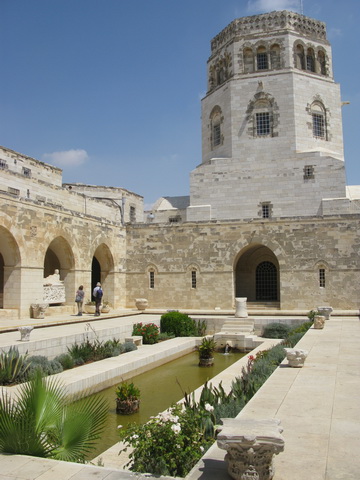
Homes built by squares inside almost each of them - courtyard.
On the inside you can climb the stairs to the balcony, who is also the roof of the first floor.

On the balconies, roofs would have these thatched arbor for leisure.

These are the courtyards.


In the Emirates, not a lot of museums, as in European countries. But if the Arabs are taken for something - they do it seriously.
On the shore of Dubai Creek stands the oldest building of the city - Al Fahidi Fort. And in it, or rather its huge cellars arranged an excellent and informative museum about the life of Dubai in the past century.

Before the fort has a real ship-dau (dhow dhau), more precisely one of the existing types of diverse Arab vessel.


But there is in Dubai and another story - the story of nature, so to speak. This swamp Ras Al Khor. Yes, yes, it is a swamp. And right next to Burj Khalifa and Dubai Mall.

In fact, it is part of the Dubai Creek, cut the town in two.
Once upon a time in all the banks in the Gulf Emirates lived millions of birds, a variety of flamingos and herons.
But the discovery of oil and the mass transport of maritime transport, urban growth and development of ports devastated coast these shores.
And that's just on the swamp was a piece of unspoiled nature.
Swamp carefully protected by the state and available for those interested in a totally free.
Also, there are telescopes and binoculars, so you can watch the birds.
History - that's good. But Emirates is also a sport country.
Highly developed different outdoor activities.
Known only in the Middle East, ski runs, and in the shopping center "Mall of Emirates"
Despite the small waves in the Gulf, one can often see the surfers.

Conquer there and the blue sky

Arabs, Italians and many others play football.
They generally highly developed amateur sports.

United Arab Emirates - it is also a car-to-country. Excellent roads, low gas prices and vehicle make Emirates a paradise for car lovers.
Here you can find all car brands. Sport, sport utility vehicles and prestigious ...

In addition to the desert and mountain terrain, Emirates interesting and motorsport fans.
In Jebel Ali, next to kartodroma spread impromptu motocross track.


Also in Dubai, there are a few go-cart track.


Here at Yas Marina in Abu Dhabi competitions in drag racing
There are also other championships, for example, GP2, Porsche Mobil-1, as well as Porsche GT3 Middle East


But most importantly, in Abu Dhabi, held one of the stages of "the queen of motorsport '- Formula 1






.jpg)


