Monday, June 11, 2012

Caesarea. First sight.

Very, very long time (about the middle of III century BC) to the shore blue Mediterranean Sea came the Phoenicians. They built a small settlement, called it the Tower of Straton and about 200 years lived peacefully and happily under the rule of the Persians at first, and then the Greeks. Plundered a little, trading and fishing. In general, behaved like all decent people of the Mediterranean.


But happiness is not eternal, and in the II century BC settlement took the king and high priest Alexander Jannaeus, who as much as 30 years have included it in the Hasmonean kingdom. Even after several decades in the places the Roman general Pompey looked and won the Tower of Straton, along with the rest of Judea. As time went on, the concept of nation-building in the Roman Empire changed in 31 BC Octavian emperor of Rome, the Jewish settlement in August gave King Herod - the same one who was going to be Great. Everyone has a dream. A dream of Herod the Great was a port city, the best in the Mediterranean. And in 10 BC it will become a small village into a major port city, named in honor of (what a surprise!) of Emperor Augustus - Caesarea. Well, and, accordingly, was in this city, as noted by Josephus, the remarkable beauty and magnitude of the Temple of Augustus, with its colossal statue, is not inferior to his model of the Olympic Zeus.


Lighthouse, a large harbor surrounded by walls with breakwaters, wharves and quays, warehouses, shops, temples, and the racetrack, the streets paved with stone slabs and fountains, sculptures and gardens, aqueducts and urban sewage.  In this city was all. No wonder after the death of Herod, Caesarea became the administrative center of the Rome prosecutor in the West and the base of the Roman legions. From there they went to suppress the revolt of the Jews, and here the prisoners were brought to punishment, and sales. And it was after the defeat of Jerusalem, Caesarea became the capital of Palestine.


Today the National Park Reserve, Caesarea, are active archaeological digs. A considerable part of them is under water. Theatre. Was built during the reign of Herod the king, and acted for hundreds of years, until the Byzantine era. The theater has two tiers and has approximately 4,000 seats. Behind the scenes perfectly positioned wall design, which relied on the column, the height of three stories and was the backdrop for the stage.


Palace on the reef. It is ruins of a beautiful palace with a swimming pool in its western part, which belongs to the Byzantine and Roman eras. Scientists believe that the pool was used as an urban fish market.


Amphitheater of King Herod. The building, which is intended for public amusements, with tiers of the arena and, in the form of an elongated U. The amphitheater was built in the days of Herod, and intended for entertainment performances and sports competitions, chariot races in Roman times. First, the building consisted of twelve rows and seats, and can hold more than 10,000 spectators.


The complex of buildings common bath. A very large complex and luxuriously decorated. Baths were constructed on the site of Herod's amphitheater, and even in their ruins can be seen the importance of baths in the Empire.


Administrative and economic area. The southern part of the construction of the Byzantine and Roman eras. A large part built on arches, which were intended for storage.


Monday, June 4, 2012

Red Canyon. Israel.

Just 15 kilometers north of Eilat, is a surprisingly beautiful place - Red Canyon. It stretches for 200 meters and a depth of 30 meters. Red Canyon is situated at an altitude of 700 meters above sea level. The name comes from the canyon reddish-pink color of one of the sandstone rock, which is the main natural product of local mountains.


Wednesday, May 30, 2012

Roads and Subway in Dubai.


UAE - an ideal country with roads and very well-organized traffic.  The country has taken to comply with traffic rules. Failure to comply shall be punished by heavy fines. Enforcement is carried out with a huge number of CCTV cameras operating in automatic mode. Receipts for payment are subject to mandatory fines, and arrive in the mail the owner of the car. If you ride in a car, rent, fines will automatically be removed from your credit card, you pay for the hire company.
The speed limit on most highways - 120 km. per hour. Speed ​​limit in the country - 140 miles. per hour. Sometimes these signs are hanging together, which is a bit misleading.

Travel on some roads is paid. Place of collection of money is called "Salic". It looks like this place as a great arch over the roadway, passing under which your credit card is debited some amount, usually 10 dirhams.
The policeman on the road are exclusively engaged in design of road accidents, which happen very rarely. But for some reason, an accident leaves immediately for 2-3 cars police.
The main condition for payment of insurance for all car rental companies - fixing the event the police. No information may have to indemnify

Sheikh Zayed Road - the main highway of the country. Highway begins in the heart of Dubai and stretches through the capital Abu Dhabi, United Arab Emirates across the country to the border with Saudi Arabia. In the center of Dubai's Road consists of seven lanes in each direction. The speed limit in the heart of Dubai on this line - 80 km. per hour.


In the cities a lot of roundabouts. Much of the road network is on the racks. 


All the interchanges are made in a big way. The scale of some of them are simply amazing.


All intersections in urban areas are tiled. Everything was done very nicely and efficiently. 
Before the crossing is always tile for visually impaired people. The sidewalk is gently lowered to the same level with the carriageway.


All temporary information signs supplemented by flashing yellow lights to attract additional attention of drivers.


In particular the completed road traffic signs are used locations corresponding to the traffic situation.


UAE - the only place in the world, which uses air-conditioned bus stops. People at these stops can be seen very rarely. I guess everyone drives on the machines. Inside each bus stop is a map of the city and the scheme of bus routes.


Subway gives the impression of its purity and processability. To the landing site can be reached, as the stairs or escalator and elevator on the transparent.


Landing site looks like. Railroad tracks and the train are separated by a glass wall area with automatic doors that completely eliminates any accidents to passengers during boarding and disembarkation of the wagons.

Absolutely everywhere you can see a special tactile markings on the floor for the visually impaired pedestrians. Interiors look very futuristic and bright.


The train driver in missing You can stand and look at the road. Very nice, especially at night. The whole system of the Dubai Subway operates fully automatically. Dubai Subway is the largest automatic Subway  network in the world.


The network really is not very big. Only two branches. Subway mostly laid on trestles over the city. Only in a few places the subway passes under the earth. Building a subway overpasses are much cheaper than digging tunnels under it.


Friday, January 6, 2012

Skiing In The Desert


All the countries of the Emirates have great entertainments. Not a lot of territory is covered by desert, mountains, modernised cities and two seas that practically are not similar to each other.

Emirates have a lot of fun to offer. You had to go to the desert on a snowboard or ski? This activity is extreme and unusual. Some slopes have a height of more than two hundred meters. To climp at the top of the slopes are used the jeeps.

If you do not want to ski on the sand, you will find a lot of snow in this country. In the terribly hot day for visitors of the country there is snow and even snow slides stadiums, ice rinks where you can ride on a sled or skate skiing. The most famous owner of this miracle is the district stadium, which is the first in the country with the modern technologies.

The most fun occupation is fishing in the Persian Gulf. In these countries the hard times associated with the fish does not happen. In the sea live tuna, barracuda, sailfish, fish, small sharks. Local cooks very tasty and skilfully prepare them for you. It is possible to catch a fish weighing 60 pounds! Just in conducting a walk on the boat, it can be well connected with catching crabs at night. Knowledgeable guide will teach you the old way of hunting for crabs with light and weapons. After the end of hunting you would expect a rich table, made from your prey.

In these countries there are incredible water-parks. They perform some shows and attractions, and show a movie on the water surface. There are hills on which it is possible to accelerate to speeds of 80 km / h, there are slides with a water upflow they differ in that their movement is directed upwards.

And of course only in the UAE is an amazing safari: entertainment in the form of races over the red sand, there are a large number of camels.

Friday, December 23, 2011

Abu Dhabi


Abu Dhabi - is a center of tourism and commerce, sport and recreation. The main landmark is the Palace of al-Husn, also known as the Old or White Fort. Next to the fairgrounds on Al Musaffah Road is the so-called Cultural Heritage Village, which played traditional way of life and way of life across the country.

Merging of past, present and future times is expressed in the peaceful coexistence of the mosques, museums, modern supermarkets, oriental markets, schools, cultural centers and arts. In Abu Dhabi, as in any Muslim city are built many mosques. From anywhere in town you can see the intricately decorated with multiple minarets.

The street Khalid Hamdan - is the focus of small shops and boutiques. Huge shopping centers, that are present in Sharjah and Dubai, are not so abundant in Abu Dhabi. The largest is Abu Dhabi Mall, and one of the most popular - Al Hana Shopping Centre, located in the center, not far from the main promenade.


The fish market - is a very picturesque place in the port area, worth a visit if not gastronomic goal, at least for photographing. The most popular restaurants of the city - Al Safina and Al Dhafra (near the fish market). Keep in mind that alcoholic beverages in Abu Dhabi are served at restaurants located within hotels. In normal urban schools reigns immutable "dry law".

In Abu Dhabi are offered a lot of interesting and varied tours: you will be offered a ride on a camel and fly in a helicopter, take a desert safari with a night under the stars and ride the sand skiing, to visit camel rides and take part in an exotic night-hunting for crabs, to shoot in the Sheikh's elite club and to fish in the waters of the Persian Gulf.

Monday, September 19, 2011

Dubai's World of Islands


Dubai's World of Islands - one of the megaprojects in the UAE, goes under water. The islands of the archipelago are modeled after a system of continents on a smaller scale and fragmented. The photographs can be clearly seen by NASA as 300 islands gradually merge with each other and drown.

Small undercurrents persist in keeping their areas, despite the artificial boundaries of the archipelago, and now everyone is wondering who and how all counted. At the moment, the project managers were forced to admit that the island is gradually receding into the sea. Given that 70% of all the islands have already been sold to private individuals, the news that the "islands show strong signs of erosion" was a bolt from the sky.

Will there be some compensation for all drowned island or debited to the "natural force majeure" as yet unknown.

Thursday, September 1, 2011


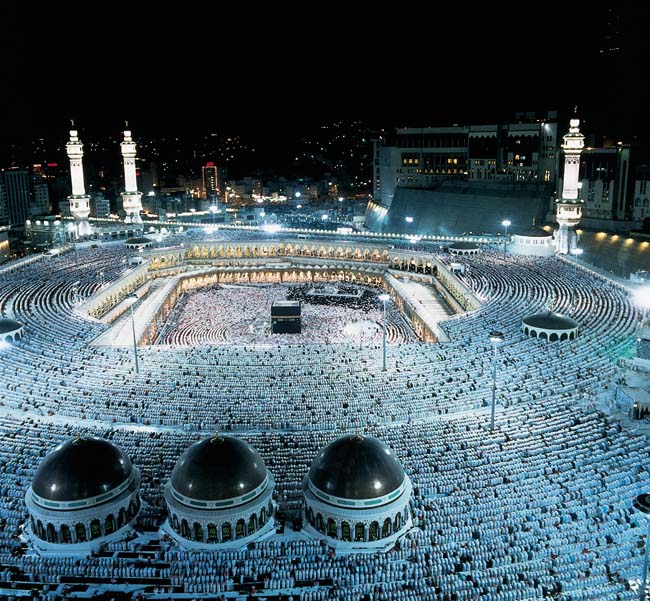
Every Muslim at least once in your life should make the Hajj - to visit Mecca. In centuries past it was difficult, troublesome and sometimes even dangerous. Hajj takes place under conditions of sufficient funds to visit Mecca and to ensure the family before returning pilgrim. If there are conditions, and Hajj is not accomplished, the sharia threatens the offender is a heavy punishment in the hereafter, and despising that debt equates to an unbeliever. On the contrary, the hajj fulfilled promises complete forgiveness of sins committed before that time, and the perpetrators of this pilgrimage proudly wore their white turban - a sign of the hajj.

In the past, everyone who came to Mecca had to find a matvafa - a guide who will provide not only a pilgrim accommodation and food, but will make sure that he did not commit errors in performing the rituals and prayers. Hajj procedure has so many subtle nuances that no Muslim (even the most earnest) on their own are difficult to handle.

At the heart of the hajj is tawaaf - a seven-fold treatment of the Kaaba. This procession symbolises the divine order in which all beings are subject to a single center - the solar system, as embodied in God. During breaking the Kaaba pilgrims reverently kiss the Black Stone, because deeply believe in Judgement Day he will call and talk to Allah the names of all the faithful, who kissed it with clean lips.

On the eighth day of Hajj from Mecca sent a huge procession to the hill of Arafat, to listen to the sermon of the Imam and perform special prayers. Approaching the hill, all the pilgrims pray without ceasing, and exclaim: "Lyabbayk" ("I obey you!"). In the valley at the foot of the hill Arafat, believers should spend the night, and only visited this hill the pilgrims receive the title of "Haj".